This is not "opal for
dummies" cause anyone who loves opal is no dummy.
The foregoing is some information about opal and the trade that I have gleaned
over the years. I do not claim to be an "expert" ( an "ex"
is a has-been and a "spurt" is a drip under pressure). But 20 years
working with opal and learning from those whov'e come before me has prompted
me to share this at the request of my customers and friends. The following
facts are regarding Australian opal, and are not mutually exclusive. There
will always be exceptions to the rules with opal.
As each opal dig produces a different
pattern and varying quality of gem, it would be safe to say that there are
no "experts" in this business,only experienced dealers and cutters and even
those of us who may claim the experience are subject to the ever changing
rules of supply and demand, coupled with the suprise of meeting with a completely
new and different material from day to day. However.....there are some basic
constants that have evolved over the years that allow us to get a benchmark.
This comes in 2 parts and follows the rule that rarity drives value. First
is base color or the background color of the material (not the fire). Second
is the fire( pattern,color mix and brightness). The hard part is that these
2 attributes will often cross over each other as I will explain.
If fire color mix and brightness are assumed to be equal across the board
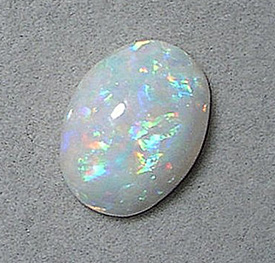
in varying base colors, then black is first in value,crystal (water clear
base) is a close second, grey or semi-black next, then jelly(translucent
like jello) and white base or "light opal" last. Boulder falls into the
dark opal or semi-black range because of the darker background.
Fire colors are also in order of rarity and here it gets a little sticky...gold
and orange are most rare but ruby red is most prized, then azure or deep
blue and green last. Pastels such as pink, light blue, light green, are
at the bottom due to low brightness. Most opal is multi-colored and it is
the dominating color that sets the value here.
Here's the cross over...black opal can be worth less than white base if
the black has only one color of very weak fire and the white has brilliant,
intense color(one or more). Some will disagree with me on this and say that
the black always has more value because it's a black opal. I like asparagus
but not brussel sprouts, oh well. Anyway, this logic applies to any combo
of base colors but in general, darker background is more prized than the
lighter because it kicks the color out and crystal is in a league of it's
own, seldom being dull and very rare at the mines.
Market grading usually falls into 3 grades, commercial grade, gem grade
and top gem. Commercial grade can be low commercial or high commercial.
Low commercial requires direct lighting to see any flash of color, will
almost always be white base(sometimes low end blue jelly) and should sell
for about $25 to $50 per oz. rough.When taken out of direct light i.e. sunlight,
halogen or a 100 watt bulb etc., the color dies. High commercial will retain
maybe half to three quarters of it's color or brightness when taken
out of direct light and should sell for about $60 to $200 per oz. rough.
Note: white base, due to it's light background, almost always requires direct
light to look it's best and therefore seldom makes it above high commercial
but it does happen.
Gem grade will retain most if not all it's color when out of direct light,maybe
not quite as bright but the full pattern is still there. Gem grade will
sell anywhere from $300 an oz. for white base to $1500 per oz. and up for
grey base, dark opal or semi-clear bands in a base material. Most "good"
opal falls into this catagory and some dark base opal such as Lightning
Ridge material will actually look better in lower light. The Aussies call
this a "shade stone". That's why Ridge material is among my favorites; I
advertise it as "glowing in candle light" and it does! So does good crystal
whether it's solid, a layer in boulder or a doublet or triplet. (Most top
grade triplets are made with crystal or semi-crystal(better than jelly)
and the rough used can cost the manufacturer $5,000 per oz. and up.
Top gem ,when out of direct light, will either keep all of it's color and
80% or more of it's brightness, or, get brighter, or, do a color shift
where the colors actually change hues due to the change in frequency of
light. This is called pleochroism or the stone is said to be pleochroic.
I once saw some crystal that under a small high intensity light was international
orange and when taken away from the light, turned violet. Good crystal and
blacks with good color automatically fall into the top gem realm at the
high end.Cost? well, you may find a small piece in a $200 or more ounce
of rough but if it's consistent through the lot, the price would be $1000
per oz. and up.
Now we come to parcel grading. It used to be that the miners did not grade
their parcels very carefully and you could get some really great deals.Today,
as more restrictions are put on mining operations and the overhead goes
up, the miners are sorting their lots closely, usually leaving a few "king"
stones to sweeten the pot. (wer'e talking commercial to gem grade here,
when your'e paying for top gem or high end gem grade, the more you spend,
the more consistent is the parcel). Most larger wholesalers buy their rough
in multiple kilo quantities. When your'e buying that much opal your'e going
to get a spread of quality in enough quantity to grade it again and still
have decent lots for sale and that's just what they do.How many times they
"cut it" determines how good a mix you get in the ounce. If I buy 5 or 6
ounces of gem grade for resale and it's not a very consistent lot, two things
are true, it isn't high end material and there aren't enough stones to grade
it again.(when your'e buying rough at $50 to $200 an ounce, there's almost
always high and low in a lot, some stones worth more than the oz. price
and some worth less, with the majority on spot, (or at least thats
the way it should be). However, if I buy a kilo (2.2 lbs.) or more, there's
usually enough stones at the high and low end to split the lot into 2 grades,
without grading too closely. I like consistency but it's not always possible
to obtain, specially at the lower price levels. The miner worked just as
hard to get that chunk of potch as he did for that bright stone next to
it and he wants to sell it all so we wind up with mixed grades in a parcel
and if the price is right, it's well worth it.
Here are a few facts that concern buying and cutting and may answer some
of the more commonly asked questions:
1) Rough opal is sold by weight...either grams (there are 5 carats in a
gram), troy ounces (31.1 grams per oz. but most of us round it to 31 grams)
or Kilograms (1,000 grams which is 32.15 troy ounces or about 2.2 pounds
U.S. Whenever I see rough for sale by the gram, I calculate what the ounce
price is..this tells me if I'm getting a good deal or not...some dealers
will sell you a good looking piece at lets say, $20 a gram, well, thats
$620 an ounce..better be darn good stuff for that...be careful.
2) Cut stones are sold by the carat (there are 155.5 carats in a troy ounce)
If you see rough being sold by the carat, it had better be very clean material...rubbed
(all or most of the waste ground off) or trimmed to the color.
3) The term "rough cut" is a contradiction, it's either rough
or cut, can't be both.
4) Potch and color is material that is potch (opal without color) that has
lines or viens of color running in it as opposed to what's called "skin
to skin" (color from one side to the other).
5) "Mine run" opal is low end material that's left after the miner
pulls out the "good stuff". It's called mine run because 90% of
what comes out of the ground is the low end.
6) Last but not least, a word about the real value of the rough you just
bought to cut...most rough is potch and color which means about 50% is going
to be waste..so..if you bought one ounce for $100 and there are 155 carats
in the ounce, your'e paying about 65 cents per carat. With 50% going to
dust on the wheel, your'e real price is doubled to $1.30 per carat cut.
Commercial grade white base (cut stones) will wholesale (what the average
jeweler will pay) at about $12 per carat....youv'e just made 900% on your
money. Try running the waste factor and carat cost on that next piece of
gem grade dark base your'e cutting (chances are it's worth at least $40
a carat) and if you don't have a carat scale, get one and stop cheating
yourself. Good opal is like real estate, theyr'e not making any more of
it and the supply is going down while the price goes up..that's why it's
called "precious" opal....Good cutting!
Go To:
The Index...Rough
Opal...Triplets...Doublets...Solids
Loose stones...Quartz
Caps...Templates...Ordering
Rings...Earrings...Pendants...Custom
Designs
Phone (541) 997-7300 or E-mail gems@opalsmith.com